Enterprise Resource Security Mastering Cryptographic Key Lifecycles

§14a EnWG and §9 EEG: Why Cryptography Is Becoming the Bottleneck in Grid Status Monitoring

November 9, 2026

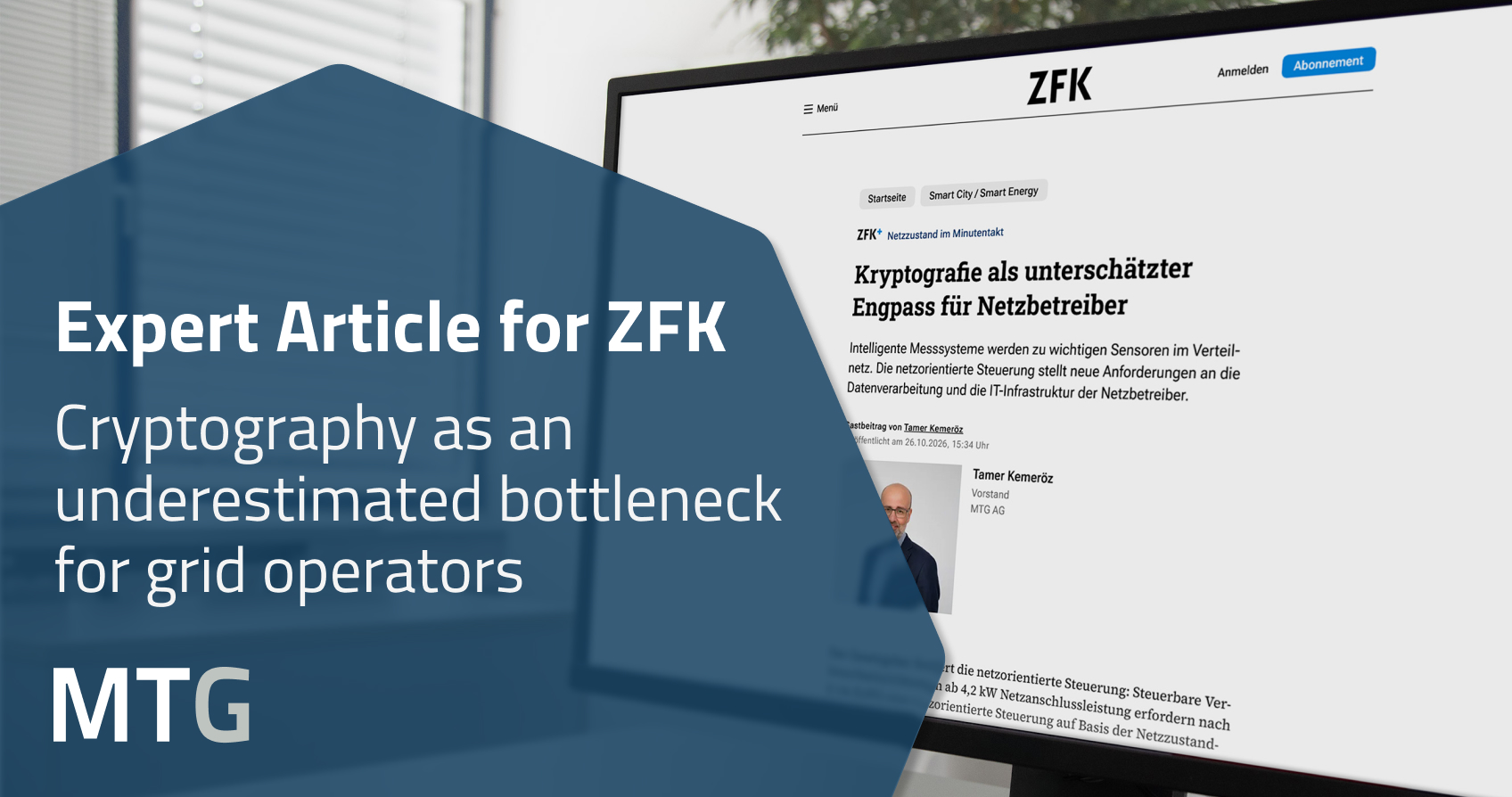
Expert Article for ZFK: Cryptography as an underestimated bottleneck for grid operators

Grid operators increasingly need to control their grids based on real-time measurements. In ZfK, Tamer Kemeröz, Member of the Executive Board of MTG AG, explains why cryptography can become an underestimated bottleneck and what grid operators can do about it.

The following text is a summary (abstract) of the key points of the article “§14a EnWG und §9 EEG: Netzzustand im Minutentakt” (Grid status every minute) by Tamer Kemeröz. The original article was published in German on October 26, 2026, in ZFK.

When Every Minute Counts

Heat pumps, EV chargers, battery storage, and photovoltaic systems are making historical load profiles increasingly obsolete. Under §14a of the German Energy Industry Act (EnWG) and §9 of the Renewable Energy Sources Act (EEG), grid operators need continuous visibility into the state of their grids and must be able to intervene at short notice. In our article, Tamer Kemeröz explains why cryptography can become an overlooked bottleneck: the requirements of the German Federal Office for Information Security (BSI) make grid status monitoring at one-minute intervals technically demanding. Without an adapted IT architecture, grid operators risk flying blind.

TK, PKI-Experte bei MTG
Tamer Kemeröz Board Member, MTG

What Is Grid Status Monitoring About?

Under §14a EnWG and §9 EEG, controllable consumer devices of 4.2 kW or more and generation systems of 7 kW or more are equipped with an intelligent metering system (iMSys) and a control box. For up to 25 percent of these connections, the metering systems transmit grid status data every minute. Processing metering data thus becomes part of time-critical grid operation.

Why Can Cryptography Become a Bottleneck?

Grid operators are familiar with the BSI requirements for TLS, signing, and encryption from AS4-based market communication. According to Tamer Kemeröz, what is new is the pace: instead of billing data bundled once a day, grid status data arrives every minute and must be processed immediately. With 100,000 iMSys, this adds up to around 36 million data records per day, many of them arriving at the same time right after the turn of the minute. Recovery after an outage is especially critical, when backlogged data and new connection setups coincide.

How Can Grid Operators Avoid the Bottleneck?

Cryptography and TLS communication must therefore be designed for peak load. Tamer Kemeröz recommends centralized, vendor-independent cryptography, for example with the MTG CryptoController and its scalable cryptographic module at Security Level 1. Management should ask service providers specifically about data volume, performance, reliability, and costs. His conclusion: market communication is becoming part of grid operation, and cryptography a performance factor.

The Full Article in ZFK

Tamer Kemeröz published his analysis in ZFK – Zeitung für kommunale Wirtschaft, the trade publication for German municipal utilities. Subscribers will find the full sample calculation, the recovery scenario, and specific questions to ask service providers there (article in German).

Questions about grid status monitoring? Get in touch with us.

MTG Expert article: "Cryography as an underestimated bottleneck for grid operators"

Frequently Asked Questions (FAQs)

What is grid status monitoring under §14a EnWG?

It continuously captures the state of the distribution grid. On this basis, grid operators manage controllable consumer devices of 4.2 kW or more under §14a EnWG, such as heat pumps, EV chargers, and battery storage; §9 EEG applies to feed-in.

How often must intelligent metering systems transmit grid status data?

Every minute for up to 25 percent of connections with an iMSys. Billing data, by contrast, is usually bundled and transmitted once a day.

Why does cryptography become a bottleneck in grid status monitoring?

Mutual TLS, signing, and encryption in accordance with BSI requirements multiply the number of cryptographic operations when data is transmitted every minute. Peak loads during recovery after an outage are especially critical.

What role do hardware security modules (HSMs) play?

HSMs protect private keys at Security Level 2. For grid status monitoring, they must be redundant and scalable in a cluster, which results in very high costs. Software-based, scalable cryptographic modules at Security Level 1 can reduce these costs significantly.

What is the MTG CryptoController?

A cryptography and communication middleware from MTG AG that provides all applications connected to the smart meter gateway with centralized, vendor-independent cryptography, including a highly scalable cryptographic module at Security Level 1.

Downloads & Links

Share This News

What can we do for you?

For further information feel free to contact us!

WordPress Cookie Plugin by Real Cookie Banner